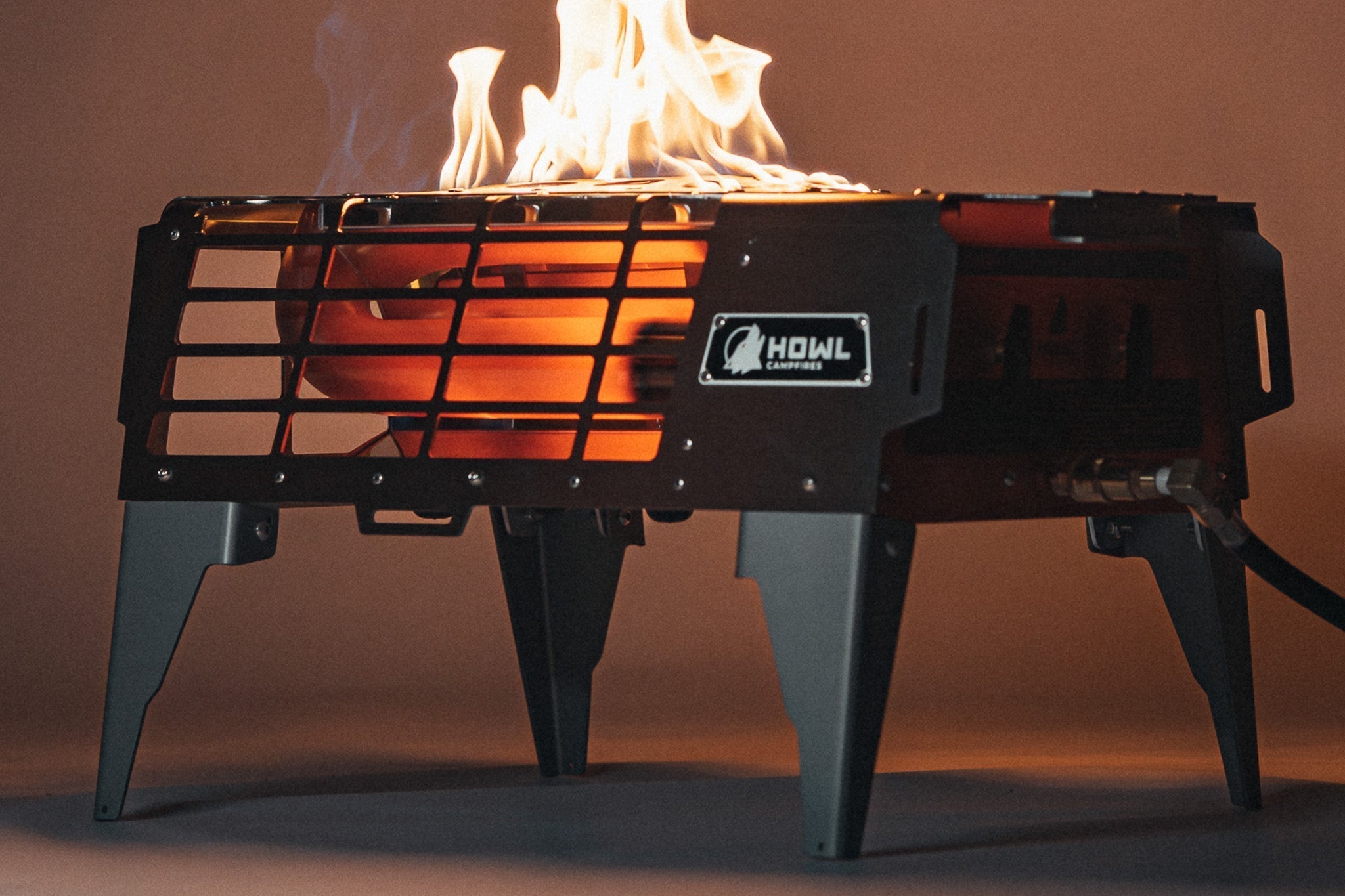


Most propane fire pits are built around a flame.
HOWL is built around combustion.
That difference matters more than it sounds. A normal propane fire pit can look fine when conditions are easy: calm backyard, mild weather, low wind, plenty of oxygen, nobody asking much from the thing except “Please make flame.”
Camp is not always that polite. Wind moves. Rain hits. Altitude changes the air. Cold makes people honest fast. That is where ordinary propane fire pits begin to show their weaknesses.
The flame may still be there. The propane may still be burning. But the heat weakens, the flame grows lazy, and the fire starts acting less like a campfire and more like a burner trying to make it through the evening.
HOWL took a different path.
HOWL is the only propane campfire built with a patented 100% Primary Air Combustion System. That is a big claim, and it is one of the main reasons HOWL can create real radiant heat in wind, rain, snow, and at altitude instead of just making pretty flames and hoping the weather behaves.
What Primary Air Means
Fire needs fuel and oxygen.
In a typical gas burner, some air mixes with fuel before ignition. That is primary air. More air reaches the flame after ignition. That is secondary air.
Most propane fire pits depend heavily on secondary air. The flame is out in the open, trying to finish the burn while the surrounding air keeps changing. That might be fine on a calm patio. It is not a great plan when the wind comes up, rain starts, or the campsite sits thousands of feet above sea level.
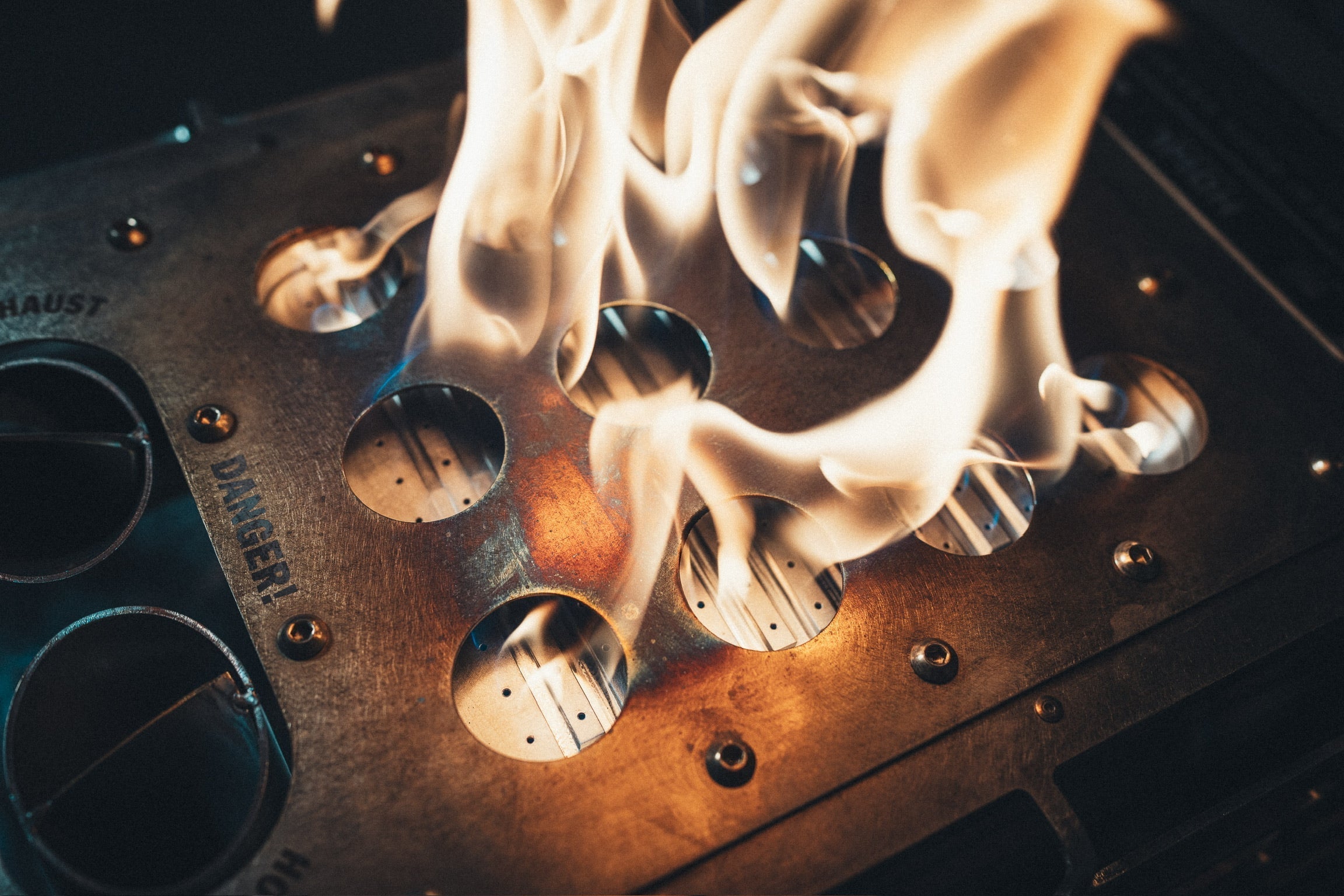
HOWL’s 100% Primary Air Combustion System changes the assignment. Instead of waiting for the open flame to find the remaining oxygen it needs after ignition, HOWL mixes the fuel and air before combustion inside the BarCoal system.
The fuel and air arrive together. The burn is controlled from the start. The heat goes where it is supposed to go.
That is the point.
Why Air-Fuel Mixture Matters
This is not some tiny technical footnote.
The air-fuel mixture is one of the biggest things that determines how combustion behaves. It matters in engines. It matters in furnaces. It matters in stoves. And it matters in a propane campfire if you want more than a decorative flame.
A car engine is a useful comparison. Cars do not just dump fuel into a cylinder and hope everybody has a nice time. The air-fuel mixture has to be controlled because it affects power, efficiency, heat, emissions, and whether the engine runs cleanly or runs like something you should not have bought on Marketplace.
Same basic idea here.
If you want a propane fire to produce useful heat, burn efficiently, and work across changing conditions, you need control over how fuel and oxygen meet. Most propane fire pits lose much of that control once the flame is exposed to the open air.
HOWL does not.
The Small Part That Makes It Work

Not much to look at. Kind of the point. As propane passes through the Fuel Jet Orifice, it helps draw primary air into the venturi before ignition.
One of the most important parts of a HOWL does not look very important.
The Fuel Jet Orifice looks like a small metal fitting. Not exactly the kind of thing most people gather around at camp and admire. Good. It is not there to be admired. It is there to do a very precise job.
As propane moves through the jet, the momentum of the fuel stream draws air into the system. That fuel-air mixture feeds the BarCoal system, heating the tubes until they glow.
If the inside of that jet is off by a microscopic amount, the mixture changes. If the mixture changes, the BarCoal tubes do not get hot enough to do their job.
That is why this little part matters. Not because it looks impressive, but because the whole fire depends on it being right.
Where Ordinary Propane Fire Pits Struggle
Most propane fire pits are open-flame appliances.
They make a flame and then rely on the surrounding air to finish the burn. That is a weak place to build from because the air around the fire is always changing.
Wind moves it. Rain interrupts it. Altitude changes how much oxygen is available.
When a fire pit relies heavily on exposed secondary air, the burn is more vulnerable to conditions around the flame. The flame can lift, flatten, flicker, weaken, or lose useful heat even if it never fully goes out.
A normal propane fire pit asks the environment to cooperate.
HOWL brings its own combustion control.
Why Wind Matters Less
Wind is one of the easiest ways to make an ordinary propane fire pit feel disappointing.
Even if the flame stays lit, the heat can get carried away. Flame shape changes. The burn gets pushed around. The fire starts behaving like something you can see, but not something that can really warm you.
With HOWL’s BarCoal system, combustion does not depend on the wind behaving itself. Because HOWL uses 100% primary air combustion, the fuel and air are already mixed before combustion begins. The BarCoal tubes are being fed a controlled mixture through the system, not sitting there hoping the open air around the flame does its part.
That is why HOWL can keep producing radiant heat in conditions where ordinary propane fire pits start making excuses.
Why Altitude Matters Less, Too
Altitude changes air density. Less dense air means fewer oxygen molecules in the same volume of air, and that can make ordinary open-flame propane fire pits struggle.
HOWL handles that differently because the BarCoal system is built around primary air combustion.
The Fuel Jet Orifice does not just meter propane. As propane shoots through the orifice, the momentum of that fuel stream pulls primary air into the venturi — the mixing passage where fuel and air come together before ignition. The orifice, air inlet, venturi, and BarCoal geometry are designed to operate as a single system, so the fuel and air are already mixed before combustion begins.
That is the important part.
A typical propane fire pit lights the flame first, then depends on secondary air around the flame to finish the burn. At altitude, the surrounding air is thinner, so the flame has less oxygen available for combustion.
BarCoal is different. The system brings air into the combustion process earlier, before ignition, instead of asking an exposed flame to find enough oxygen after it is already burning.
That does not mean altitude ceases to exist. It means HOWL controls the fuel-air mixture before combustion and has designed the system to produce radiant heat across a wide range of elevations.
That's why we can talk about working from Death Valley to Pikes Peak.
Not because the fire is ignoring physics.
Because the combustion system was built around it.
Why BarCoal Gets So Hot

Most propane fire pits are mostly flame.
Flame gives you light. It gives you some heat. But a lot of that heat goes straight up, which is exactly where your knees, boots, hands, and cold friends are not.
HOWL’s BarCoal system is different. The 100% Primary Air Combustion System heats the BarCoal tubes until they glow. Those tubes become a radiant heat source, sending infrared heat outward toward the people sitting around the fire.
That is why HOWL feels different from a typical propane fire pit. It is not just making flames and hoping you feel warm.
It is creating radiant heat.
The kind you feel on your legs, your hands, your boots, and the side of your face when you are sitting close enough to remember why people like campfires in the first place.
Why This Is Not Just a Bigger Burner
You can always make a propane fire pit burn more fuel.
That is not hard.
The harder thing is turning that fuel into useful heat. The kind of heat that survives wind. The kind that does not disappear straight into the sky. The kind that still works when the weather is doing weather things.
That is what 100% primary air combustion lets HOWL do. It gives the system control before the burn occurs, rather than trying to recover after the flame is already at the mercy of the environment.
That is the difference between building a propane appliance and building a campfire.
A normal propane fire pit asks the weather to cooperate.
HOWL does not.
That is why primary air combustion matters. And it is why no other propane campfire feels like a HOWL.