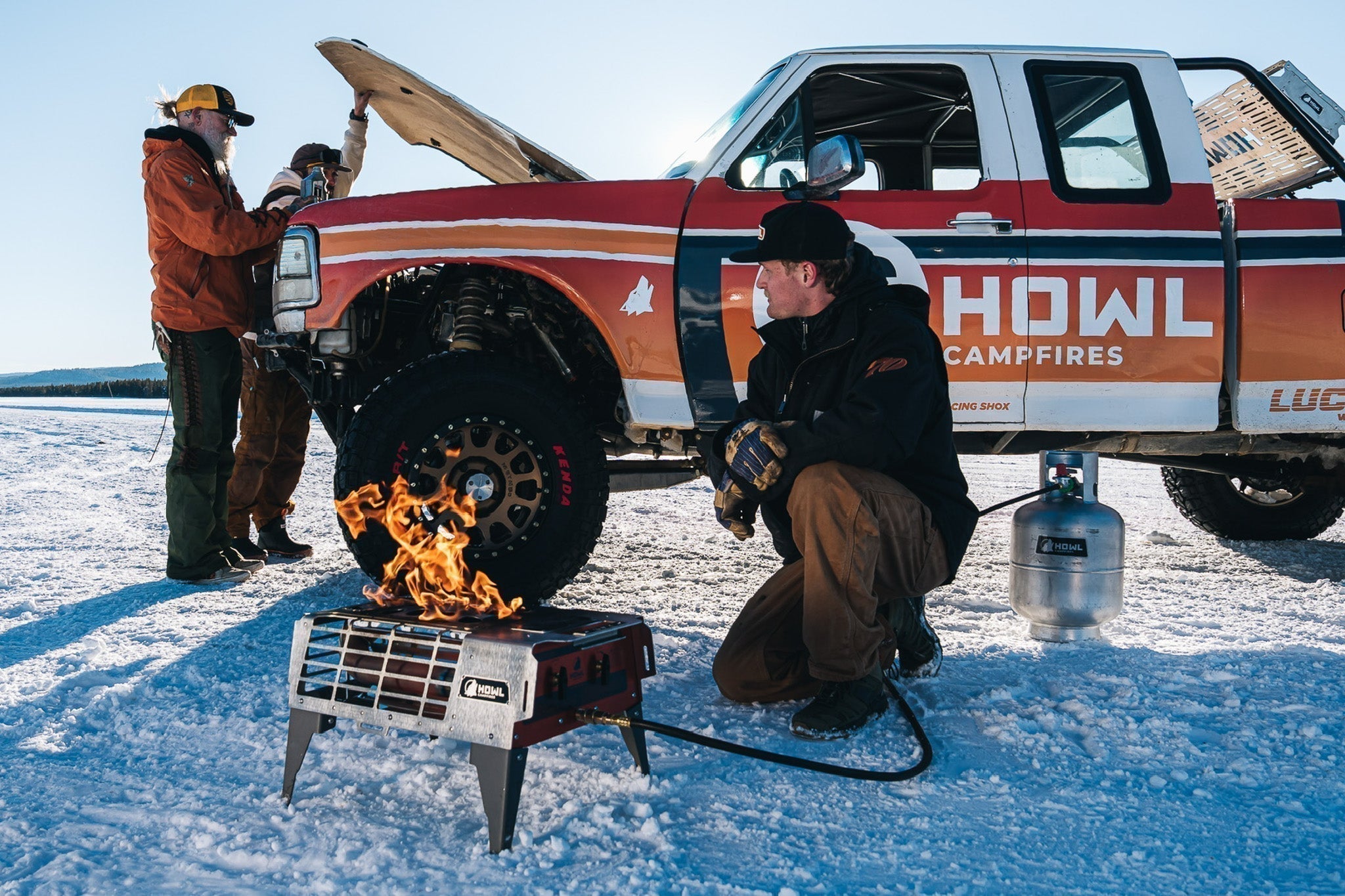


Walk up to a HOWL Campfire, and you'll probably never think twice about the Mission Control Knob.
Good. You shouldn't.
A control knob is one of those parts people only notice when it feels cheap, sticks, leaks, breaks, or gets smashed off the side of the fire pit.
Nobody has ever said, “Great trip, but I really wish the propane valve felt more expensive.”
That was the problem.
We didn't want a valve hanging out in space waiting to get whacked by a cooler, boot, camp chair, tailgate, or whatever else gets thrown around camp.
We wanted every control recessed into the Mission Control Panel.
Turn it one way, the fire comes on. Turn it back, the fire goes off. That's exactly how it's supposed to work.
The funny part is that little Mission Control Knob cost us about $40,000. Not because it's fancy, but because nobody made the one we needed.
Start With the Best

Eventually, we landed on the American-made Kantleak Ball Valve. It was originally designed to control refrigerants in commercial HVAC systems, not propane.
That mattered.
Propane molecules are smaller than refrigerant molecules, so a valve that seals perfectly for one doesn't necessarily seal perfectly for the other. When the valve underwent propane certification, it failed.
The solution wasn't to start over.
It was to engineer a new gasket that would allow the valve to pass certification while keeping the protected, recessed design we'd wanted from the beginning.
Why It Costs So Much
Getting a new valve configuration certified for propane isn't just somebody checking boxes.
Under UL standards, the valve has to survive 6,000 complete on-and-off cycles. After that, it still has to pass hydrostatic testing without leaking.
The tolerances are incredibly tight. Components are tested under extreme conditions because "almost sealed" doesn't count when you're controlling propane.
By the time the testing, engineering, certification, and documentation were finished, we'd spent roughly $40,000 getting that one little brass valve approved.
Why We Think It Was Worth It

It would've been a lot cheaper to redesign the campfire around an off-the-shelf valve.
Instead, we built the campfire we wanted.
The R1 uses one Mission Control Knob to control the A-Flame.
The R4 MKii uses two—one for the A-Flame and one for the BarCoal system.
Most people will never know the back story. They'll just turn the knob.
That's exactly the point.
The best engineering isn't the part you notice.
It's the part you trust without ever thinking about it.