
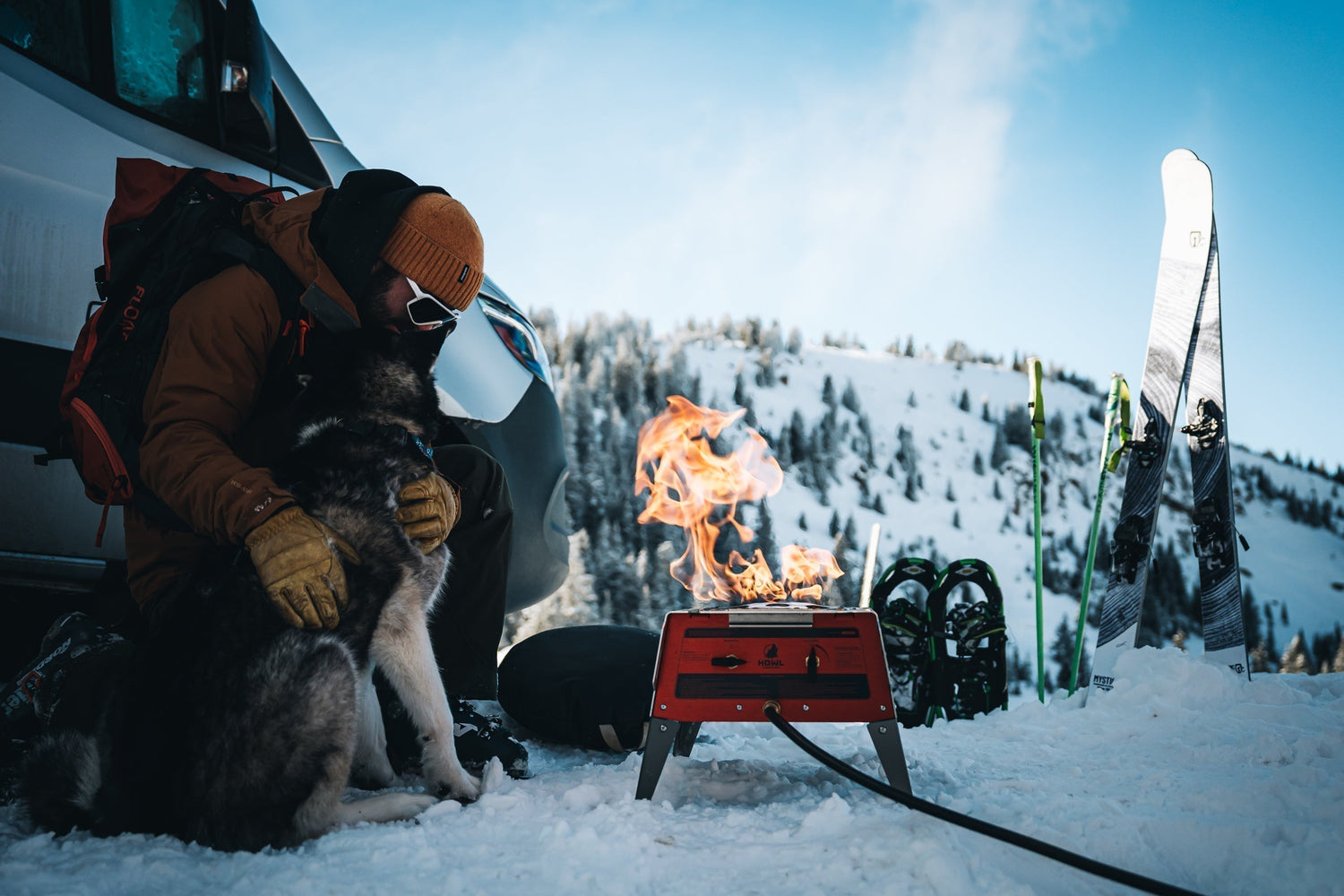
Take an ordinary propane fire high enough into the mountains, and it starts dealing with the same problem you do: less oxygen in every breath.
Most propane fire pits leave their flames out in the open and depend on the surrounding air to finish the burn. As altitude, temperature, humidity, and wind change that air, the fire changes with it.
BarCoal doesn’t wait until after ignition to go looking for oxygen. It uses the pressure of the propane itself to draw in the air it needs, mix the two together, and send the mixture into a protected combustion chamber before anything burns.
There is no altitude sensor, fan, computer, or little knob labeled MOUNTAINS. The adjustment happens naturally through fuel pressure, airflow, and some very carefully engineered geometry.
Basically, we built a backward carburetor into a campfire.
We’ll explain what that means without assuming you spent your childhood rebuilding dirt bikes.
FIRST, THE A-FLAME AND BARCOAL DO DIFFERENT JOBS
 The A-Flame brings the party. BarCoal makes sure nobody leaves because they can’t feel their feet.
Before getting into airflow, we need to clear up one thing: flames absolutely make heat.
HOWL’s A-Flame creates real warmth along with the tall, exposed firelight people want from a campfire. In the R1, it makes a damn good summer-season fire for nights when you want light, atmosphere, and enough heat to take the edge off.
BarCoal does a different job. Propane burns inside a stainless-steel tube until the tube glows, turning it into a powerful radiant heat source. Instead of mostly heating the air, BarCoal sends heat directly toward your body—more like the glowing coal bed of a wood fire.
That is what turns the R3 into a three-season campfire. The R4 uses two BarCoal tubes, making it the true four-season HOWL for camping when the weather is serious, and your thighs would prefer not to freeze.
The A-Flame makes heat and firelight. BarCoal brings the deeper radiant heat that keeps the party going when summer is long gone.
FIRE NEEDS A RECIPE
Propane cannot burn by itself. It needs oxygen, and it needs the correct amount.
Too much propane and not enough air creates a fuel-heavy mixture that burns cooler and dirtier. Too much air and not enough propane also drops the temperature. To get BarCoal ripping hot, HOWL needs to hold that mixture in a very narrow range.
The important question is when the air joins the fuel.
Primary air mixes with propane before ignition.
Secondary air reaches the fuel after ignition, while the flame is already burning.
Most propane fire pits depend heavily on secondary air. They light the propane first and trust the open air around the flame to supply the rest of the oxygen. That works well enough when the weather cooperates. Wind, rain, and altitude are under no obligation to cooperate.
BarCoal uses 100% primary air. It collects all the air required for combustion, mixes it with the propane, and sends the complete mixture into the BarCoal tube before ignition.
The fire does not have to chase oxygen after it starts burning. It arrives with everything it needs.
THE PROPANE DOES THE PULLING

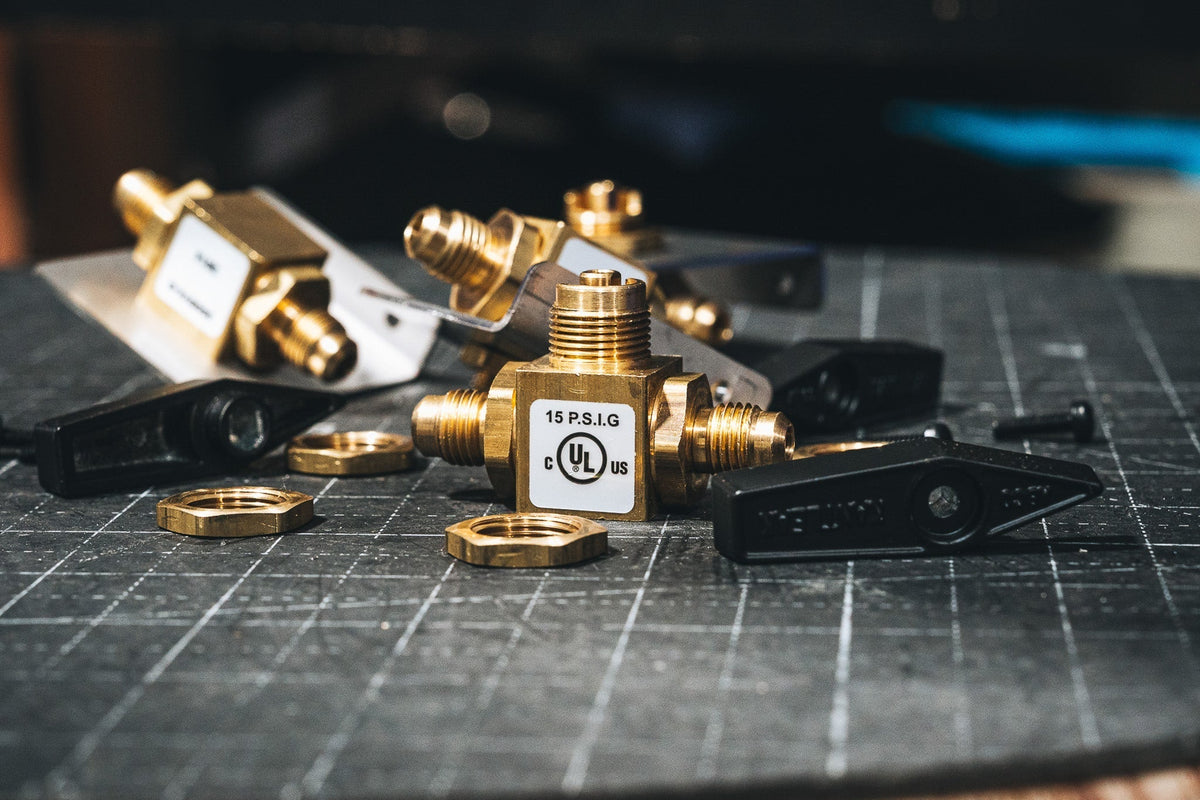
Nobody wants this much scrutiny. The hole in this tiny bastard is so stupidly precise, it takes the same kind of Swiss screw machine used to make Rolex watch gears.
The first BarCoal prototypes ran brilliantly at 15 psi. Then ANSI standards told us we had to make the whole thing work at 5 psi.
Turning down the pressure was easy. Keeping BarCoal just as hot and stable was the engineering equivalent of pulling a truck with one-third of the engine.
The regulator delivers propane to the HOWL at a steady 5 psi. Inside, the Fuel Jet Orifice forces that propane through a microscopic opening, turning it into a narrow, fast-moving stream. It works like putting your thumb over the end of a garden hose: the amount of water may not change, but the smaller opening makes it shoot out much faster.
That fast-moving propane creates the pull that brings air into the system.
Outside air first enters through the vents built into the bottom of the HOWL. We call this the Skid Plate Air Intake. From there, the air enters an enclosed chamber protected from wind and weather.
The propane jet pulls air from that chamber through smaller air-inlet openings surrounding the Fuel Jet Orifice. The air and propane meet before either one gets anywhere near a flame.
Then the mixture enters the venturi.
WHAT THE HELL IS A VENTURI?
A venturi is a specially shaped internal passage that narrows and then opens back up. As gas moves through that narrow section, it speeds up, and the pressure around it drops. That low-pressure area helps pull air into the moving propane stream.
If you know engines, the arrangement works a little like a backward carburetor. A carburetor uses moving air to pull fuel into an engine. HOWL uses moving fuel to pull air into a campfire.
If you don’t know engines, forget we said carburetor. The important part is simple: the propane moves fast enough to pull its own combustion air along with it.
The mixture then passes through six perforated metal layers, each turned slightly from the one before it. That forces the propane and air to change direction repeatedly and mix thoroughly before ignition.
By the time it burns inside the BarCoal tube, the fire already has the air it needs.
BARCOAL DOESN’T MEASURE AIR BY THE CUP
Here is the simplest way to understand altitude: a cup measures space, not how much actual air is inside that space.
Near sea level, the air is packed tightly. A cupful contains plenty of air—and plenty of oxygen.
On a mountain, the air is spread out. The same cupful contains less actual air, so it also contains less oxygen. A burner that always takes in the same cup-sized volume will run short on oxygen as it climbs higher.
This is also why humans suffer at altitude. Your lungs still take in roughly the same-sized breath, but that breath delivers less oxygen. Your body tries to compensate by breathing harder and faster, which is why a climb that feels easy at sea level can leave you sucking wind in the mountains.
BarCoal does not take one fixed-size breath.
Its fast-moving propane jet pulls air continuously through the Skid Plate Air Intake, into the protected chamber, through the air-inlet openings, and into the venturi.
When the air is thin, each cubic foot contains less actual air and is easier for the propane jet to move. Because the propane jet still has the same pulling force, it draws a larger volume of that lighter air through the system.
At lower elevations, each cubic foot contains more actual air and takes more force to move. The same propane jet therefore pulls a smaller volume of that denser air through the system.
The volume changes in the opposite direction of the density: thinner air means more volume flows through, while denser air means less volume flows through. Those two changes balance each other, keeping the actual amount of air reaching the burner nearly the same.
BarCoal does not sense the altitude and make an adjustment. It does not need to. The propane jet, venturi, and changing air density make that adjustment naturally.
From Death Valley to Pikes Peak, the volume changes. The amount of oxygen reaching the burner does not.
TEMPERATURE AND HUMIDITY CHANGE THE AIR, TOO

Great view. Thin air. BarCoal does not care.
Altitude is not the only thing that changes air density.
Warm air spreads out and becomes less dense. Cold air packs together and becomes denser. Humidity changes the weight and makeup of the air as water vapor moves in and out.
Those changes are usually smaller than what happens when you climb thousands of feet, but BarCoal handles them through the same natural balancing act.
When the surrounding air becomes lighter and easier to move, the propane jet pulls a greater volume through the system. When the air becomes denser and harder to move, it pulls a smaller volume.
HOWL doesn't need to measure temperature or humidity and calculate a correction. The physical relationship between the fuel jet and the surrounding air handles the change as it happens.
No sensors. No electronics. No weather app asking whether your campfire would like to enable location services.
WIND DOESN’T GET TO CHANGE THE MIXTURE
Most propane fire pits burn out in the open. Wind blows across the flame, changes the air reaching it, and carries away much of the heat.
HOWL brings air into the fire through the Skid Plate Air Intake underneath the campfire. That air then enters an enclosed chamber inside the HOWL, where it is protected from direct gusts.
The fuel jet pulls air from this protected chamber instead of depending on whatever the wind happens to throw at an exposed flame. Once the air and propane have mixed, they ignite deep inside the BarCoal tube.
Wind can beat the hell out of the outside of the campfire without taking control of the combustion inside it. That is how BarCoal kept burning during testing in winds up to 120 mph.
The A-Flame remains an exposed flame because that is its job: giving you tall, visible firelight. BarCoal keeps the serious heat protected inside the tube.
WHAT HOWL ACTUALLY PATENTED
HOWL did not patent propane. We did not invent the venturi, and we do not own the general idea of mixing fuel and air before ignition.
U.S. Patent No. 11,959,645 protects the specific system we developed to turn those principles into a portable campfire.
That protected arrangement includes the curled radiant heating tube, the reflector positioned within it, the separate flame burner above it, and the burner system that uses a gas jet and venturi to pull in combustion air before ignition. The patent also covers the layered metal-mesh burner that forces the mixture through six perforated layers, each rotated 15 degrees from the next, along with claims covering fanless operation and fuel pressure of about 5 psi.
Those parts do not work as a pile of independent tricks. They operate together as one combustion and heating system.
Other companies can make propane fire pits. They can use venturis and primary air in other products. They cannot legally copy HOWL’s patented arrangement in the United States while the patent remains active without our permission.
They have to find a genuinely different way to solve the problem.
We know how hard that is. It took us three years.
THE ADJUSTMENT IS BUILT INTO THE FIRE

Against all odds, the campfire has better fuel management than the race truck.
From the outside, you turn a knob and light the HOWL.
Inside, propane passes through the 5 psi regulator and Fuel Jet Orifice. The moving fuel pulls outside air through the Skid Plate Air Intake, into a protected chamber, through the air-inlet openings, and into the venturi. The fuel and air mix before ignition, pass through six offset mesh layers, and burn inside the protected BarCoal tube.
Every piece has a job. Together, they keep the air-fuel mixture stable as altitude, temperature, humidity, and wind change around the campfire.
No fan to power, sensor to fail, or separate altitude adjustment to remember. The fire handles the changing air through the same physics that made the problem difficult in the first place.
You may still suck wind at 10,000 feet.
BarCoal won’t.