
BIGGER FLAMES. BIGGER HEAT. LESS FUEL.
Most propane fire pits make short flames, then hide them down in a bowl. You get less light and less heat for every BTU of fuel you burn. That leaves you cold.
HOWL’s A-Flame is different. It builds a taller flame with less fuel, and the whole flame stays visible and exposed. That means more firelight reaches your camp, which is nice. But the thing you’ll really notice is that more heat reaches your body.
Here’s how it works.
MORE FLAME MEANS MORE HEAT YOU CAN FEEL.
Flames send heat in two directions: outward as radiant heat, and upward as hot air.
Radiant heat travels straight from the flame to your body. It’s the heat you feel on your face when you toss a big branch of dry pine needles on campfire. That big, bright flame throws off a lot of radiant heat.
Flames also make a lot of hot exhaust gases. Those hot gases rise, carrying the heat away with them.
That’s why most people hate propane fire pits. Their flames are short and buried behind walls. The walls block the radiant heat, while the short flames mean less surface area to radiate heat outward.
All you’re left with is hot air that rises and blows away. Cute decoration, but no heat to warm you up.
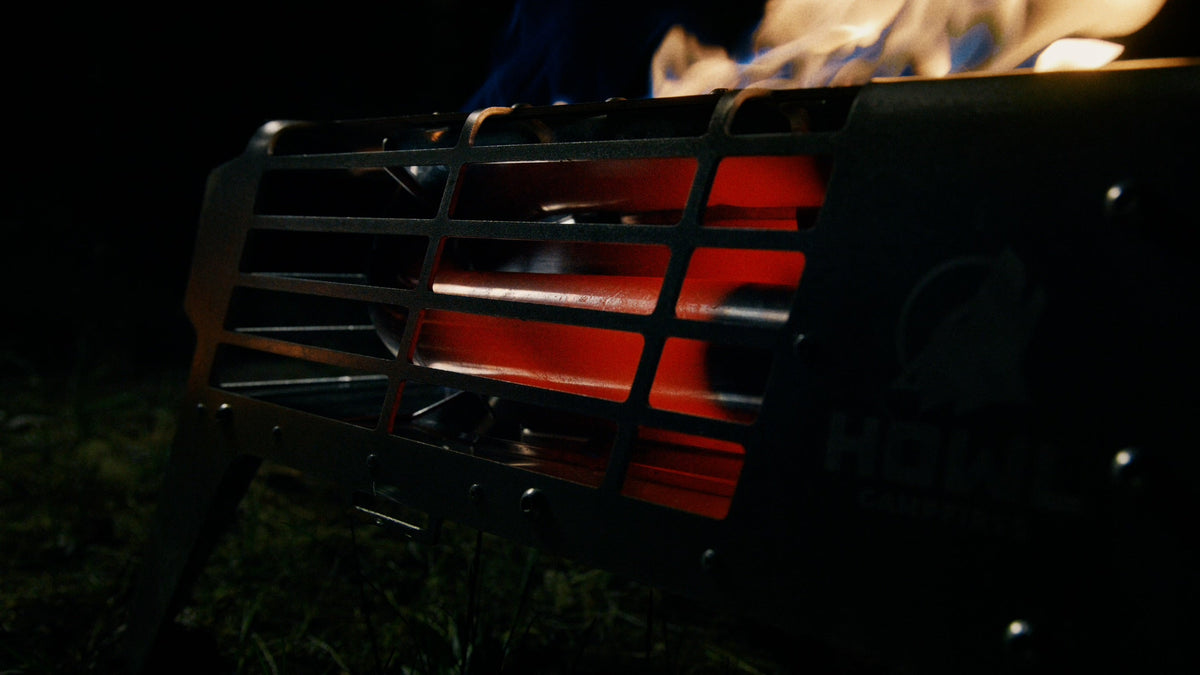
HOWL’s A-Flame stretches the flame skyward and keeps it completely exposed. With more flame surface area, and nothing to block it, you get serious radiant heat headed your way.
160 TINY FLAMES TURN INTO ONE BIG ONE.
Remember when you were a kid and put two lighters together to make one freakishly tall flame? A-Flame does the same thing, but on steroids.
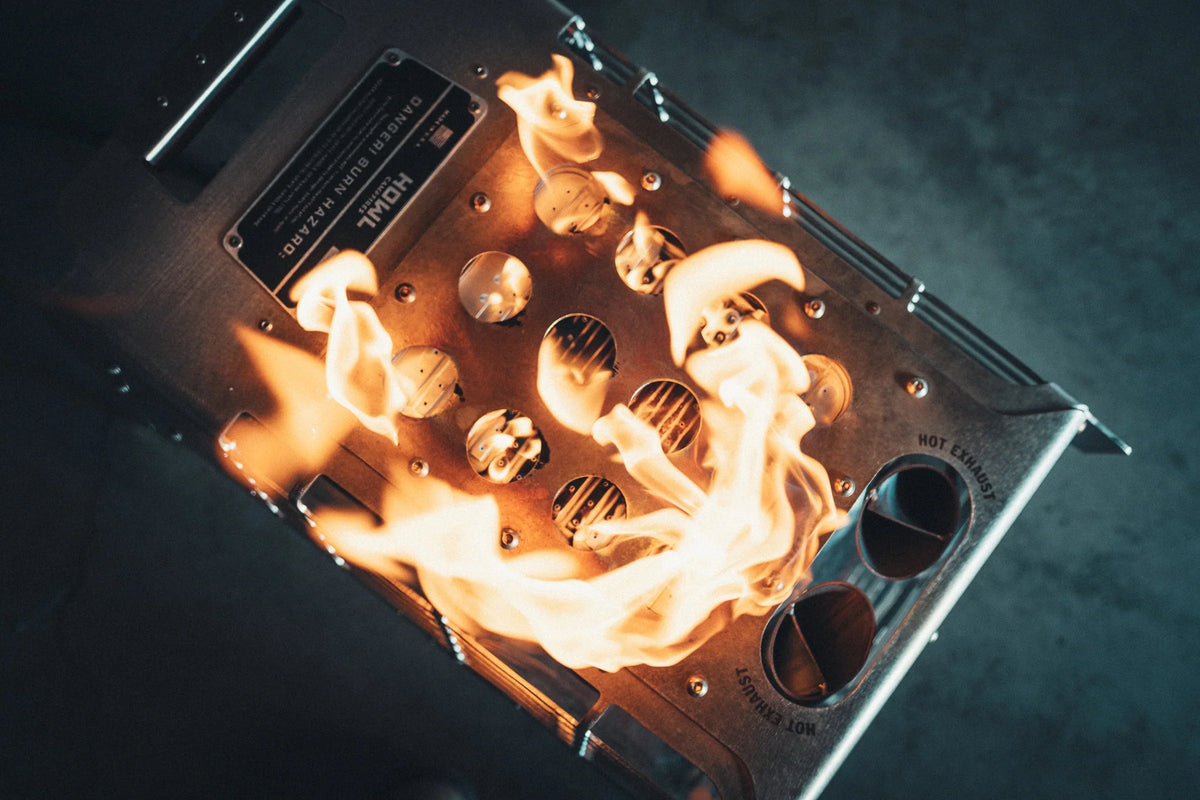
Instead of a few large holes in a copper pipe, A-Flame uses 160 precision-machined fuel micro-emitters. Each emitter makes a tiny flame. Together, they stretch skyward to make a bright, leaping tall flame.
Stretching the flame gives it more surface area without burning any more fuel. That’s how the R1 can keep cranking waist-high flames for 8 hours on a single 20-lb tank.
TALL FLAMES THAT CAN TAKE A GUST.
The reason everyone else hides their flame behind walls is wind. Exposing a flame makes it more susceptible to being blown out.
So HOWL’s engineers developed a horizontal windscreen that protects the flame without hiding it.
The FlexDome Windscreen sits over the burner plate and creates laminar separation. Wind flows over the top, while the air below stays largely undisturbed. That gives the base of the flame a sheltered place to live, even in 65 mph gusts.
Strong wind can make the flame duck down momentarily. But when it passes, the flame stands back up. It’s like a wood fire that leans with the wind, then reaches skyward again.
RAIN RUNS OFF. THE FIRE KEEPS GOING.
Rain and snow can ruin a burner when water pools where it shouldn’t. The A-Flame Plate is convex in shape, so water runs off instead of sitting on the burner. Drain gutters along the edge of the burner carry the water away.
That’s how the A-Flame keeps burning in pouring rain and heavy snow.
BIG FLAMES WITHOUT CHEWING THROUGH YOUR TANK.
Before A-Flame, fire pits made taller flames by pushing more and more fuel through the burner.
Some companies advertise fire pits that use as much as 280,000 BTUs of fuel per hour. A 20-lb tank holds 430,000 BTUs of propane, so those fire pits make for a very short night.
A-Flame uses the principles of fluid dynamics to stretch the flame skyward without dumping more gas.
The R1 makes a 32-inch flame using 54,000 BTUs of fuel per hour.
The R3 and R4 make 24-inch flames using 31,000 BTUs per hour.
That’s a big flame with a lot less fuel.
Every HOWL Campfire is built with A-Flame Technology. To get the right HOWL for you, there’s just one question you need to answer…
HOW MUCH HEAT DO YOU NEED?